What washes up has a return address.
Tracing ocean plastic to its makers.
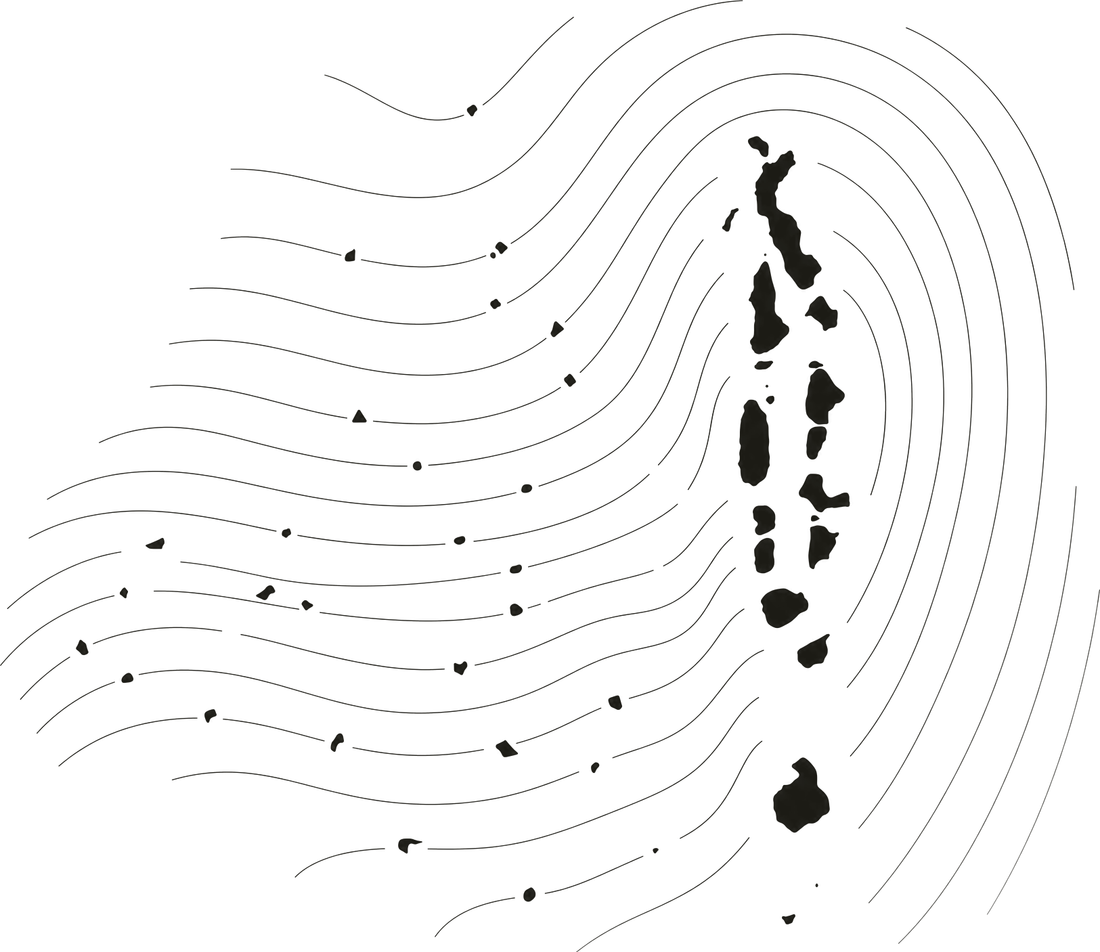
Driftprint began on the beach. On trips around the Maldives we kept finding plastic bottles washed up far from any shop that sold them, so we started photographing them. The photos piled up, and one question stayed with us: where did all of this come from?
Almost none of it was made here. The bottles ride in on the monsoon currents from countries hundreds of miles away. The Maldives produces very little of the plastic that ends up on its reefs, yet it pays to clean it up.
The label is the clue. A brand, a script, a barcode, a batch code. These survive the ocean, and they point back to a maker. Read the label and a piece of anonymous trash becomes a named product with a country of origin. That is where the name comes from. Drift is how it arrives. Print is the mark that gives it away.
So we started keeping a record. Each item is photographed, traced to the company that made it, and placed on a map with the date, the place it was found, and the route it likely travelled. The point is a set of evidence you can cite: who produced it, where it came from, and how it reached this shore.
Driftprint is a Zero Waste Maldives initiative. It follows the brand-audit method used in coastal cleanups around the world, where collected waste is sorted and counted by producer. The dataset it builds is meant for donors, researchers, and policymakers who want to hold producers responsible for the plastic that leaves their factories.
How it works.
- 01
Collect and photograph
Walk the tideline and photograph each bottle the same way: the label front, the label back, and the bottle’s shape. Consistent shots are what make hundreds of finds read as a record instead of snapshots.
- 02
Place it on the map
Each find is located from the photo’s GPS data, or by a pin you drop, and stamped with the date it was found. You do not need an account. Sign up only if you want your finds credited.
- 03
Read the label
People, not machines, identify the brand, maker, and country. Weathered, curved, and multilingual labels defeat automatic text recognition, so it is a shared job. On the Verify page anyone can suggest details from the photos or confirm ones that look right. Confidence builds in stages: needs identification, then community-backed, then a ✓ Verified ID a moderator confirms once the evidence holds.
- 04
Trace the journey
Once the maker is known, its factory is pinned, or its country as a fallback, and a line is drawn from the origin to where the bottle washed ashore. That line is the return address.
- 05
Cite the evidence
Every find gets a catalog number and joins the open dataset, free for donors, researchers, and policymakers to use in the case for producer responsibility.
The dataset is free to use, share, and build on for non-commercial purposes, with attribution. Please credit the Driftprint Project, a Zero Waste Maldives initiative.


